Recently, I set myself a very analogue challenge of walking the entire length of London’s Circle line that covers 27 stations. No trains or shortcuts. Just me (and hubby), a map, some street signs and a lot of curiosity. It wasn’t just about putting one foot in front of the other, the journey became an unexpected blend of old-school navigation, futuristic tech sightings and a reminder of why I focus my work on bridging the gap between industry and education.
A Map, a Mission and Minimal Google Maps
Armed with a traditional printed map and my ability to decipher street signs, I kept my digital assistance to a bare minimum, only consulting Google Maps twice (yes, I counted!). This was a conscious decision, not just for the nostalgia of getting lost the “proper way,” but to experience the city more deliberately. The result? A deeper engagement with London’s layout, architecture and unexpected surprises tucked in side streets and behind grand facades.
For me, this exercise of wandering through the streets by feel and focus was also a metaphor, in education and in life, we sometimes rely too much on shortcuts, such as GPS-style solutions instead of building the underlying skills to navigate uncertainty.
Tech in the Wild – Spotting a Wayve Car in Chelsea
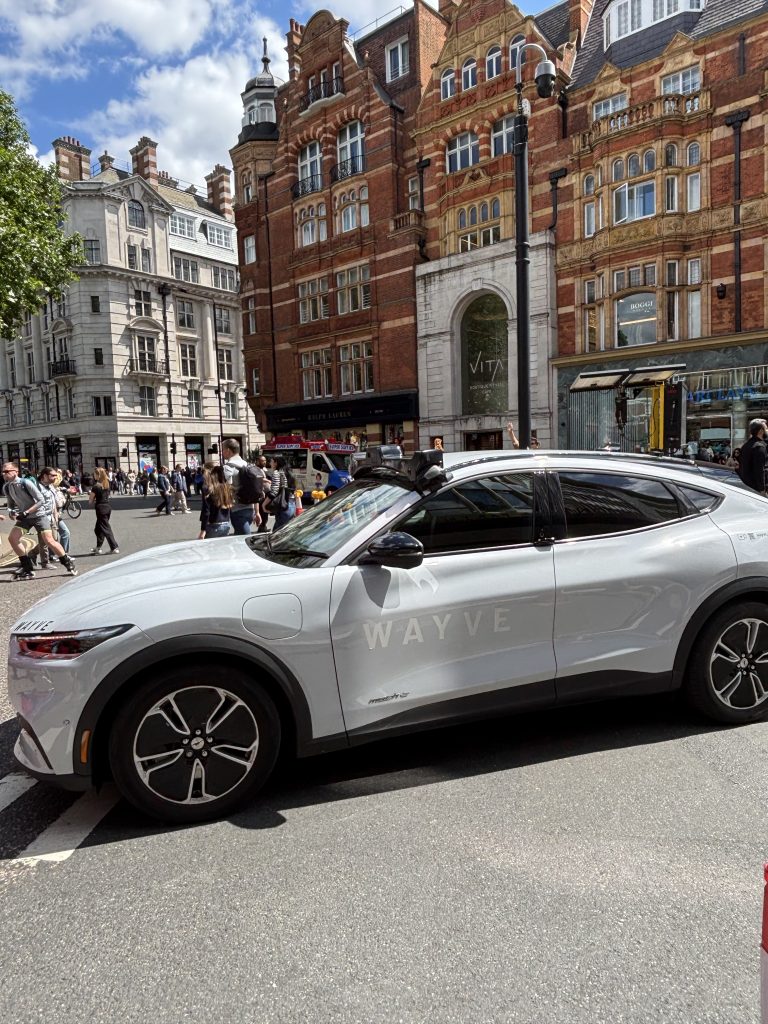
By total chance, as I navigated the crowds in Chelsea who were taking photos of the wonderful “Chelsea in Bloom”, I spotted a Wayve autonomous vehicle. If you’ve not come across Wayve yet, they’re a UK-based startup at the forefront of AI-driven, self-driving cars. (I previously saw one of these types of vehicles and rode in them in San Francisco – read that blog here)
In the photo I took (see below), you’ll notice a privacy statement on the car. This is a goldmine for classroom discussion:
- What does it mean to be recorded in public?
- What rights do individuals have in a world of sensors and data-hungry machines?
As someone who’s long been fascinated by the autonomous world, seeing this car move through one of London’s most historic neighbourhoods was symbolic – the old and new coexisting and intersecting. Isn’t that exactly what smart cities are about?
Smart London: 5 Tech Touchpoints Along the Way
As the walk continued and I had to start digging deeper, as my feet got a bit sore, I kept my educator hat on and started mentally tagging the ways in which London quietly showcases its status as a smart city:
- Smart Traffic Management
Adaptive traffic signals were visibly adjusting flow based on real-time conditions. These systems reduce congestion and pollution, improving quality of life for city dwellers. - Excellent Connectivity
For friends and family we checked in at each station, connectivity around the capital was excellent. - Real-Time Public Transport Info
Walking past stations, bus stops, and cycle stands, digital displays showed live transport updates. Perfect examples for classroom discussion of how data translates into service. - EV Infrastructure and Charging Stations
I passed numerous electric vehicle charging stations, some sleek and barely noticeable, others marked boldly. Their presence shows how London is quietly transitioning to cleaner transport.
- Smart Shops and the Future of Retail As I made my way through the capital I passed several Amazon Fresh stores, a quiet but significant sign of how London is embracing the next wave of retail, with checkout-free shops that use a blend of AI, computer vision and sensors to track shopping and shoppers.
From Industry to Education: What This Walk Reinforced
This wasn’t just a personal challenge, it was a reminder of why I work to bridge the world of industry and education. The world around us is evolving rapidly, driven by tech like AI, autonomous systems, and data science. But if our students don’t see, touch or question this transformation in their daily lives, they may leave education with patchy theoretical knowledge and practical confusion.
Walking through London with my eyes open to both past and future helped reinforce a few things:
- Real-world context matters. You can’t teach urban mobility or AI ethics from a textbook alone.
- Curiosity leads learning. I didn’t plan to see an autonomous car – but when I did, it gave me lots of ideas
- Achievement isn’t always digital. The satisfaction of completing a physical challenge reminded me that not all goals need an app or a screen. Sometimes, it’s just about doing the thing.
Nine Hours, Slightly sore feet and a Lifelong Memory
Sure, my feet were sore by the end. But what I gained was a fresh lens on London, tech in action, forty three thousand steps and ideas for the classroom, to share when I deliver training. It was a walk through history, the future and the space in between.
So if you are ever looking for a way to reconnect with the city, reimagine your teaching or just challenge yourself – ditch the tube for a day. Let the city reveal itself to you one station at a time.
And if you spot a Wayve car while you’re out there, take a moment to ask – who’s watching whom?
Hi, I am Beverly and I work to bridge the gap between industry and education. Here are a few ways in which you can work with me.
- Book me to speak at your event
- Work with me as your strategic advisor
- Share the message of my childrens’ book series
- Explore this site and find out more about my work and reach out today!