Introducing the periodic table for AI in education
As educators we are constantly looking for fresh ways to encourage curiosity to get critical thinking going and to engage young people and conversations about technology and its impact upon our world, so I have created the periodic table of AI in education to do exactly that – it’s a structure we all recognise including young people.
I feel the strength of this periodic table is that it can be used for conversations in class and also for INSET days.
Why does it have this dual appeal?
Artificial intelligence is cutting across everything that everyone is right now in their lives. The periodic table of AI in Education offers technologies, applications, tools, empowerment, challenges and future possibilities.
This tool isn’t about memorising anything it’s here to help you to discuss, debate and reflect – ultimately helping everyone to navigate the world of AI with confidence and responsibility. The table is split into 6 categories
- Core Technologies – the science behind AI, such as machine learning and natural language processing.
- Applications in Education – adaptive tutoring, chatbots and automated grading.
- Teaching Support Tools – AI helping teachers with lesson planning, content creation and assessment design.
- Student Empowerment – tools that support learners, from accessibility features to AI study aids.
- Ethics & Challenges – bias, privacy, equity, accountability and intellectual property.
- Future Directions – where we’re headed, with human–machine collaboration, extended reality and ethical design.
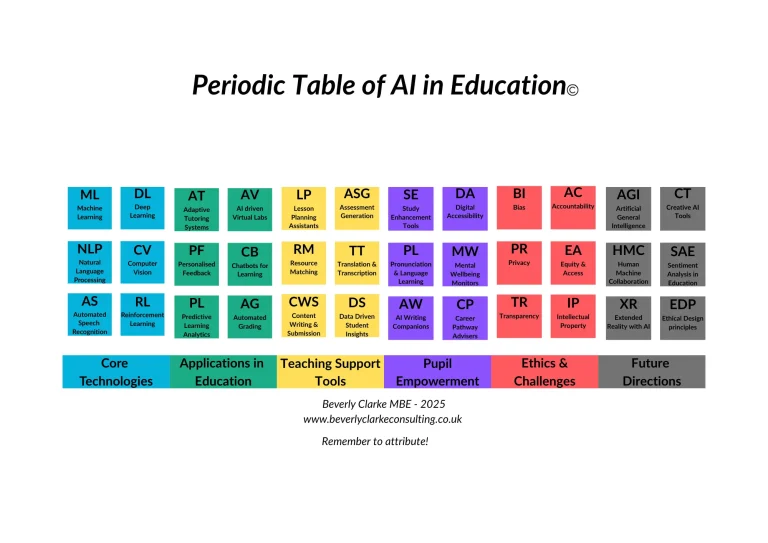
Here are some ideas on how to use this periodic table with different age groups.
- Ask pupils to take one feature such as Chatbots, then imagine and talk about how Chatbots will help them learn in future – What could go well? What might go wrong?
- Another activity may involve placing the different elements – such as Computer Vision, ChatBots, Translation and Transcription, AI Writing Companions into categories of – “Good for us” or “Risky for us”, this will help to bring about conversations around ethical thinking at it in an age appropriate
- Another idea is to look at some of the tools already being used in everyday life that are recognisable so young people are able to spot where AI is showing up in their lives, for example in smart speakers, YouTube captions etc.
- Older pupils can look deeper by looking at an issue, and considering ethics and challenges of using AI to potential “solve the problem”, perhaps looking at it through the lense of the items featured in the Ethics and Challenges section.
AI isn’t just a future concern its here and is right now! It is shaping education, workplaces and society. The AI concepts here should be accessible and familiar and we should debate and reflect across all age groups on upon them.
Have you enjoyed this periodic table of AI in Education, here are ways you can work with me:
Hi, I am Beverly Clarke MBE, here are some examples of my AI work:
- Member of the UK Government Digital, AI and Technology Task and Finish Group
- Resource writer for K–12 AI curricula
- Speaker on AI in education at conferences
- Given evidence at the All Party Parliamentary group on Artificial Intelligence
- Guest writer for ITN Business
I work at the intersection of industry and education, helping organisations and educators make sense of emerging technologies.